




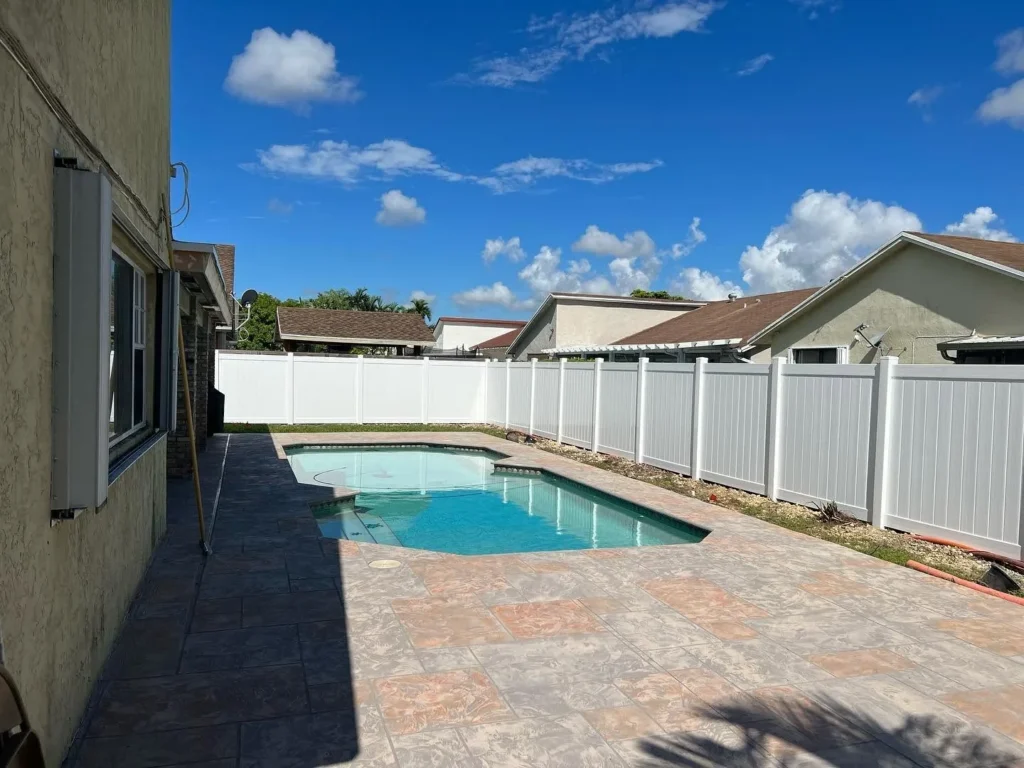
If you’re building a pool in Miami-Dade County, or you just want to know whether your existing pool fence is up to code, the short answer is that Florida law does not simply require “a fence.” It requires one of five specific safety options, and if a fence or barrier is the one you choose, that barrier has to meet a detailed engineering spec, not just be four feet tall. Here’s exactly what the law requires, what Miami-Dade County adds on top of it, and what it actually costs to get it right.
The Florida Residential Swimming Pool Safety Act
Florida Statute 515.27, the Residential Swimming Pool Safety Act, has applied to new residential pools since October 1, 2000. Before a new pool can pass final inspection, it must have at least one of the following safety features in place:
- A barrier (fence, wall, or enclosure) that meets the requirements of F.S. 515.29
- An approved safety pool cover meeting ASTM F1346
- Exit alarms on all doors and windows with direct access to the pool
- Self-closing, self-latching devices on those same doors, with the release mechanism at least 54 inches above the floor
- A pool alarm that detects entry into the water, certified to ASTM F2208
A fence is the most common choice because it’s a one-time installation rather than equipment that needs monitoring, but it’s worth knowing the law gives you options. Skipping all five is a second-degree misdemeanor, though the charge is dropped if you install a compliant feature within 45 days.
Pool Fence and Barrier Requirements
If you go the fence route, F.S. 515.29 and the Florida Building Code spell out real engineering requirements, not just “four feet high.” The main ones:
- Height: at least 48 inches above grade, measured on the outside of the barrier
- Bottom clearance: no more than 2 inches between the ground and the bottom of the barrier
- Openings: no gap anywhere in the barrier may allow a 4 inch diameter sphere to pass through
- Vertical members: if horizontal rails are spaced less than 45 inches apart, verticals must be spaced 1¾ inches or less apart, with horizontals facing the pool side
- Chain link: mesh openings no larger than 2¼ inches square, unless slats reduce the opening to 1¾ inches
- Gates: must be self-closing and self-latching, must open away from the pool, and the latch release must be positioned so a child can’t reach it from outside
Mesh pool fencing has its own separate spec covering post strength, mesh tensile strength, and a 45 inch minimum latch height, since it’s a removable system rather than a fixed structure. Whatever material you choose, we can walk you through which spec applies. See our pool fence installation page for the options we install.
Miami-Dade County’s Permit Process
Miami-Dade County requires a barrier permit to be pulled at the same time as your pool permit, and the pool cannot legally be filled with water until the barrier passes final inspection. If you’re adding a pool to an existing property, plan for both permits to move together rather than treating the fence as an afterthought once the pool is already dug. We handle this permitting as part of every pool fence installation, see our fence permits and design consultation page for how that process works.
Does This Apply to an Existing Pool?
Pools built before October 1, 2000 are generally grandfathered in and aren’t retroactively required to add a barrier under state law. That said, three things commonly override the grandfather clause in practice: pulling a permit for pool renovation or resurfacing typically triggers current code, homeowners insurance carriers frequently require a compliant barrier as a condition of coverage regardless of the pool’s age, and if you’re selling the home, a buyer’s inspection or lender may flag it. If you have an older pool without a compliant fence, it’s worth checking with your insurer even if the county doesn’t require it.
Can Your HOA Require More?
Yes. Under Florida homeowners association law, an HOA can impose pool fence rules that are stricter than the state and county minimums, for example requiring a specific material, color, or additional height, but it cannot require anything less protective than what the law already sets. If your community has design guidelines, we can build to both the code minimum and your HOA’s requirements at the same time.
What About Community and Condo Pools?
Shared pools at condos, apartment complexes, and HOAs are not governed by the Residential Swimming Pool Safety Act. They fall under separate, generally stricter, Florida Department of Health public pool rules. If you’re asking about a pool at your single-family home, Chapter 515 is what applies to you.
What Does a Code-Compliant Pool Fence Cost in Miami-Dade?
Cost depends heavily on material. General South Florida market ranges, installed:
- Mesh pool fencing: roughly $15 to $25 per linear foot
- Aluminum: roughly $45 to $75 per linear foot
- Vinyl: roughly $50 to $80 per linear foot
- Glass panel: roughly $100 to $200 per linear foot
For a typical 120 to 180 foot pool enclosure, that puts most aluminum installations in the $5,400 to $13,500 range before permit fees, which generally run from under $100 to a few hundred dollars depending on scope. These are planning ranges, the only way to get an exact number for your property is a free site visit and written estimate.
Frequently Asked Questions
Do I need a pool fence if my house doors already have alarms?
No. The law requires one of five options, a barrier, a safety pool cover, exit alarms, self-latching doors, or a pool alarm, not all of them. If your doors already have compliant exit alarms or self-closing, self-latching hardware, you may already meet the requirement without a fence. Many homeowners still choose a fence because it doesn’t rely on equipment staying functional over time.
My pool was built before 2000. Do I have to add a fence now?
Not automatically under state law, pools from before October 1, 2000 are generally grandfathered. But pulling a permit for any pool work typically triggers current code, and most homeowners insurance policies require a compliant barrier regardless of the pool’s age, so it’s worth checking your policy even if the county doesn’t currently require it.
How high does a pool fence have to be in Miami-Dade County?
At least 48 inches above grade, measured from the outside of the barrier. That’s the state and county floor, your HOA can require it to be taller.
Can my HOA require a different pool fence than the state law?
Yes, but only in the stricter direction. An HOA can require a specific material, color, or greater height, but can’t approve anything less protective than F.S. 515.29 already requires.
What size gaps are allowed in a pool fence?
No opening in the barrier may allow a 4 inch sphere to pass through, the gap between the ground and the bottom of the fence can’t exceed 2 inches, and vertical picket spacing is generally limited to 1¾ inches when horizontal rails are close together.
Do I need a permit for a pool fence in Miami-Dade?
Yes. The barrier permit is pulled alongside your pool permit, and the pool can’t be filled with water until the barrier passes final inspection. We handle this permitting process for you as part of installation.
Get a Code-Compliant Pool Fence Installed Right
We install and permit pool barriers across Miami-Dade County, built to meet F.S. 515.29 and the Florida Building Code from day one. Send us your project details for a free, written estimate.
This article is for general information and is not legal advice. Requirements can change and local officials have final say, always confirm current requirements with the Miami-Dade County Building Department before starting a project.